15 June
Casino RoyaleIn Casino Royale, 15 June marks the anticipated start of Le Chiffre’s attempt to make fifty million francs at baccarat and the day Bond confronts his bank at Royale. What begins as a calculated operation becomes a public contest of endurance: Bond must read the game, commit his diminishing capital, and decide how far to follow a bank that could determine both men’s futures.
A date fixed by the operation
The date first appears in the account of the planned counter-operation. Le Chiffre is expected to seek a fifty-million-franc profit on working capital of twenty-five million, a gain intended not only to repair his financial position but also to save his life. The plan is to defeat him at the tables, discredit the Communist trade union whose funds he has misused, and weaken its influence; killing him is explicitly rejected as counterproductive, since his sponsors could conceal the financial failure and turn him into a martyr.
Royale’s casino has leased its baccarat and two leading chemin-de-fer tables to the Mahomet Ali Syndicate, a group of Egyptian bankers and businessmen competing for a share of the high-stakes French baccarat business. The expected influx of wealthy gamblers and the syndicate’s operation make Royale the setting for a contest whose outcome reaches beyond the players seated at the table. In the operation’s timetable, 15 June is the point at which the political and financial plan is to be tested through gambling.
Bond prepares to play
Bond approaches the casino as a serious gambler, not simply as an agent carrying out orders. He values the concentration of the tables and the personal responsibility of a wager: a player must distinguish bad luck from bad judgment, and accept that the result can be blamed on himself. His reflections acknowledge that chance cannot be mastered, even as he treats it as something to be studied and engaged rather than feared.
That mixture of discipline and intuition appears in his roulette routine. Bond borrows the chef’s card to inspect the recorded sequence of the ball, although he knows each spin is independent of the last. He watches the croupier’s practiced motions and the wheel’s design, then attends to runs that other players might regard as meaningful. He does not claim that this practice changes the odds; he maintains that effort and ingenuity are part of what he brings to gambling.
For the baccarat confrontation, Bond expects to begin with roughly the same capital as Le Chiffre. He explains that he intends to attack the bank whenever it is offered, continuing until one of them breaks the other. Le Chiffre’s position as banker gives him a slight advantage, while Bond hopes that the knowledge of a determined opponent, combined with uncertainty about Bond’s funds, will unsettle him. Bond’s account of the rules also makes clear how decisions depend on both probability and information: a player’s choice to draw or stand gives the banker evidence about the hand, while the uncertain decision over a five remains a test of intuition.
The bank and its ritual
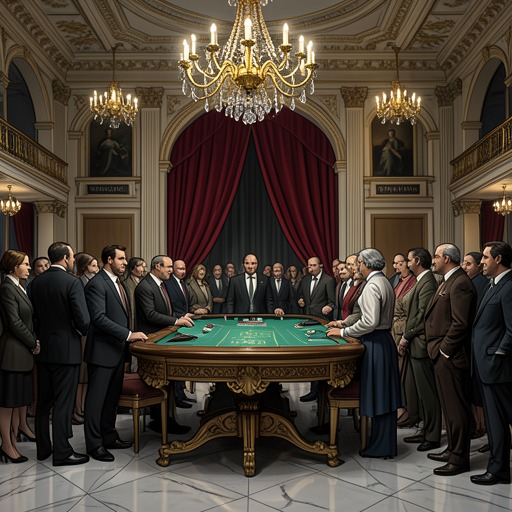
Le Chiffre has bought the baccarat bank from the Egyptian syndicate for one million francs, leaving him with twenty-four million in capital. The game is played at a kidney-shaped table, with Le Chiffre as banker and a croupier and chef de partie supervising the dealing and stakes. The cards come from six packs shuffled in view of the players, cut by one of them, and placed in a shoe. Bond and his associates have checked the staff and are alert to possible cheating, though marking the cards would be difficult and would require the croupier’s cooperation.
The opening bank is five hundred thousand francs, offered around the numbered seats until a player accepts it or the table combines to cover it. As the bank grows, finding a single player or group able to meet it becomes harder. Bond intends to take the offered stakes himself whenever possible, turning the rules of the table into a direct test between his capital and Le Chiffre’s.
The encounter is staged through repeated, formal gestures. Bond divides his twenty-four million francs into two equal packets and takes his place opposite Le Chiffre. The banker enters the ringed-off table, the six packs are fitted into the shoe, and the first bank is announced. The croupier deals card after card while the players follow the subdued language of bets and calls. The procedure gives the contest its public form: each decision is made under the eyes of the other players, and each rise in the stake makes private calculation visible to the room.
Loss, escalation, and the decisive stake
The first stages establish the game’s changing scale. Bond follows the Greek player’s lost bet, and the bank rises from its opening level. The early play is described as the beginning of a long sequence that will continue until the players disperse; afterward, the cards will be destroyed or defaced and the table covered. The green baize becomes a temporary arena in which fortunes are counted and losses publicly acknowledged.
Bond’s capital then falls sharply. In two coups he loses twelve million francs, leaving exactly sixteen million—the amount of the next bank. The loss is not merely a setback: it brings him to the limit of the money he can immediately put forward, while Le Chiffre’s apparent success makes the bank’s continued growth more dangerous. Bond nevertheless says he will follow, and the contest proceeds on terms that threaten to eliminate him.
Later, Le Chiffre’s bank reaches thirty-two million francs. Bond reasons that Le Chiffre may need only one more coup to achieve his fifty-million-franc objective and leave the table. Rather than let the table share the stake or cover only part of it, Bond sees a chance to force a confrontation over the whole amount. He believes Le Chiffre will not expect anyone to cover thirty-two million and does not know that Bond has access to the contents of an envelope. The reasoning turns on unequal information: Bond can make a commitment that Le Chiffre cannot confidently anticipate.
Bond calls the full thirty-two-million-franc stake. The amount draws attention across the casino; for many onlookers, it represents more than a lifetime’s earnings. Casino officials check the bet, and the chef de partie asks Bond to confirm the stake. The wager is thus both a strategic move and a public declaration of commitment: Bond has converted his secret reserve into a visible challenge to Le Chiffre’s bank.
Significance of the date
The narrative attaches 15 June to a contest in which procedure and chance operate together. Bond studies odds, sequences, and the information conveyed by each player’s decisions, yet the result cannot be reduced to calculation. The repeated calls, the handling of the cards, and the rising stakes make uncertainty legible as a collective spectacle, with the casino crowd witnessing the cost of each decision.
The date also links the personal and political stakes of the operation. Bond’s resolve to break Le Chiffre’s bank is intended to undermine a much wider financial and political position, while Le Chiffre’s need to win is bound up with his survival. At the table, those distant consequences are compressed into capital, cards, and the decision to follow. The available account leaves the thirty-two-million-franc coup poised at the moment of play: Bond has made his challenge, and the outcome remains unsettled in this sequence.